
Sun Valley Address History Sources
Past residents leave different kinds of traces at different times. A current Assessor card is the starting point for the parcel, not a record of every former household. Recorded transfers provide the ownership path. Directories and census schedules can add a historical address or household clue, while newspapers, maps, and probate materials can supply context. The era table keeps the known access dates and gaps visible so a missing online result is not mistaken for a missing historical record.
| Source | Era covered | Where held | What it can show |
|---|---|---|---|
| Recorder online index | November 1991 to current | ICRIS | Party-indexed recorded instruments, not an address search |
| Recorder online images | August 16, 1999 to current | ICRIS | Recorded document image subject to portal rules |
| Recorder books and microfiche | Before November 1991, exact series varies | Recorder counter and research repositories | Older index and deed references |
| Assessor current card | Current card with sales and valuation fields | Washoe Assessor | Parcel, owner or trustee, situs, transfers, and legal description |
| UNR city directories | Early directories beginning in 1900 | UNR Digital Collections | Person and address clues; complete year run is not posted |
| Federal census | 1790 through 1950 public release | NARA, library, and family-history resources | Household composition at a census date |
Begin with the most recent parcel and work backward. Switch to the counter, books, microfiche, library staff, or archival material when the desired date predates an online system.
Sun Valley Parcel Card First
Enter the exact situs address or APN in the Washoe County Assessor Property Search. Save the APN, current owner or trustee, situs, mailing address, legal description, subdivision, map references, sales or transfers, and last-document date. The distinction between situs and mailing address matters. Situs identifies the physical parcel. The mail address may be a tax-billing destination, an attorney, a trust, or a location outside Sun Valley. It is not evidence that the addressee lives at the situs.
Preserve the legal description and map references with the APN. A parcel can be split, merged, given an additional unit, or associated with a changed postal line. Those land-based fields are stronger continuity markers than a modern street label alone. The Assessor also cautions that its data is for assessment purposes and may not be a complete representation of the parcel or improvement.
Note: Current ownership and former occupancy are separate questions, so date every parcel field before using it in an address history.
Sun Valley Deed Chain Backward
A chain of title follows recorded transfers of an interest in land. In Washoe County, the pathway runs from the Assessor’s sales or transfer row to ICRIS, then from the seller on one deed to that seller’s earlier acquisition. The goal is not to search an address in the Recorder. The goal is to translate a known parcel and transfer into a party-name and approximate-date search, then preserve the document information that keeps the chain tied to the same land.
- Start at the current Assessor card and copy the APN, legal description, document number or date, current owner or trustee, and listed grantor and grantee from the transfer data.
- Open ICRIS and search the current buyer or grantee with the approximate recording date. Locate the purchase deed or other transfer instrument.
- Record the document number, recording date, parties, document type, legal description, and image or copy status from the result.
- Take the seller or grantor from that instrument and search that party as an earlier grantee. Check spouse, trustee, estate representative, and business-entity variants only when the document identifies them.
- Repeat the loop, matching the legal description and parcel references at every step. Before the online cutoff, move to Recorder books, microfiche, staff help, and library or archive sources.
The public Washoe Recorder ICRIS index is the online point for the party-and-date portion of this work.
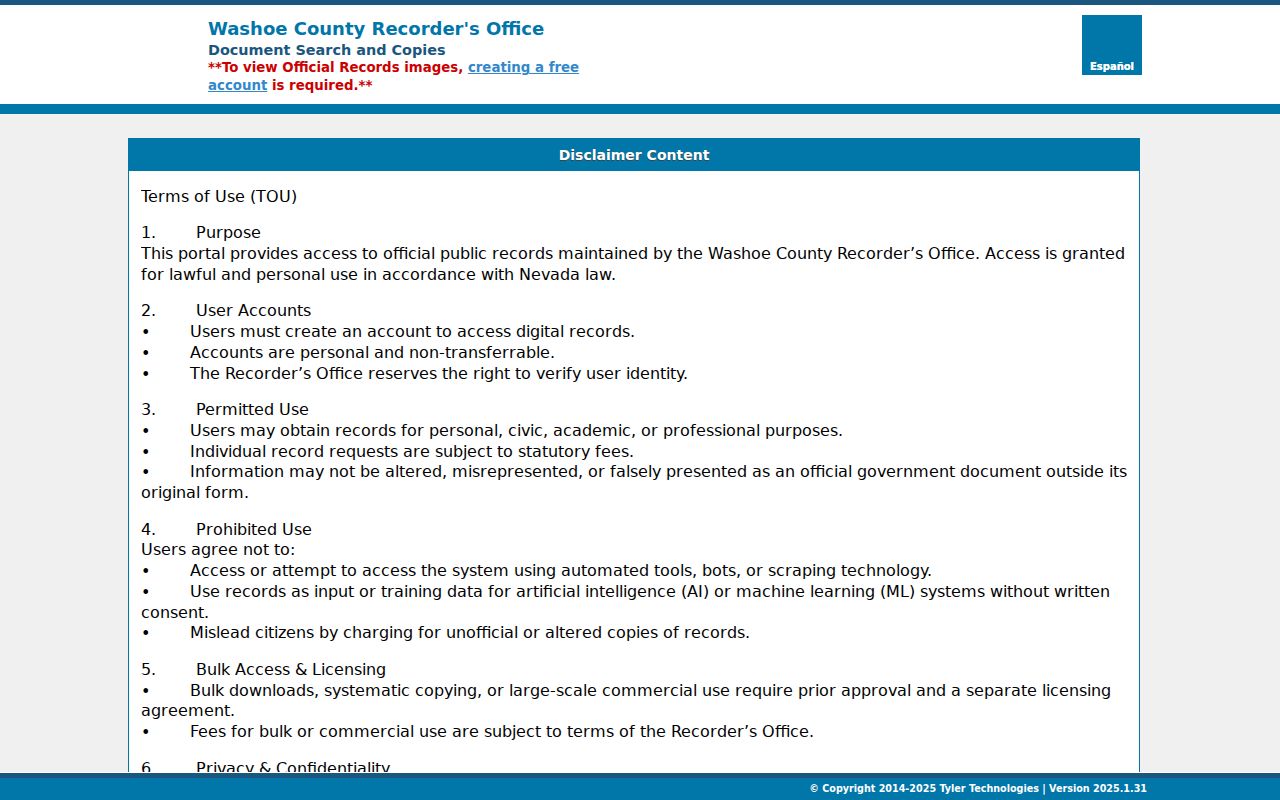
Each recorded document can supply the next party and date, but the title trail remains reliable only when it stays attached to the correct parcel description.
Sun Valley Recorder Name Quirk
ICRIS is deliberately not an address-search system. The Washoe Recorder directs users to search a party as last name, space, first name, with no comma, and to include an approximate date. The system does not directly search situs, legal description, or parcel number. Its APN indexing began in 2016 and was supplemented from Assessor data, but the Recorder warns that the APN coverage is not complete or guaranteed.
This name-format rule is a useful check when a deed seems absent. Return to the Assessor transfer row, try the exact party form shown in the document, and preserve the date range. A grantor transfers an interest; a grantee receives it. The same person can appear in different roles as the chain is traced backward. Do not assume that a trust, company, or mailing address identifies an individual occupant.
Sun Valley Older Deed Access
The online-versus-counter split is one of the key limits in a past-resident search. The Recorder’s real-estate index begins online in November 1991, and online document images begin August 16, 1999. Earlier index material is held in books and microfiche. The office can be contacted by online request, phone, email, mail, or at its Reno counter, rather than leaving older research to an empty online result.
Recorder copies also have different channels. The research identifies a free unofficial watermarked real-estate document download, a plain copy at $1 per page, and a certified-copy addition of $4, subject to the office’s current schedule. The county also has a general public-records request portal for records outside a specialized system. Keep a request narrow by date, document type, party, APN, or recording number.
Note: A digitized historical book or a selected UNR scan is not the same as a complete, searchable online Recorder index.
Sun Valley Title Trail Terms
These terms keep the backward search anchored to land and date. They also make it easier to spot a false match when a surname is common or a modern address has changed.
- Grantor
- The person, estate, trust, or other party transferring an interest in a recorded instrument.
- Grantee
- The party receiving that interest. A prior seller is commonly searched as an earlier grantee to continue the chain.
- Chain of title
- The sequence of recorded transfers connected to the same parcel or legal description.
- Legal description
- The recorded land description used to connect documents when street names, units, or postal labels shift.
- Criss-cross directory
- An address-first directory that can connect a street number to a listed person for a particular volume year.
Use the legal description, subdivision or parcel maps, and record-of-survey references to check a possible title link. An APN is a helpful cross-reference, not proof that a historic parcel was never reconfigured.
Sun Valley Library Address Clues
After the deed chain identifies a time period, Downtown Reno Library can supply the occupant layer. Its FAQ offers staff searches of city directories and telephone books when a request includes names, dates, and any address portion. The library confirms current and historical area directories, but the inspected sources do not publish an exact reverse-directory run. Request an address-first or criss-cross volume for the target year, and keep the returned listing tied to that specific volume.
The Downtown Reno Library reference-service information identifies the directory and telephone-book assistance route.
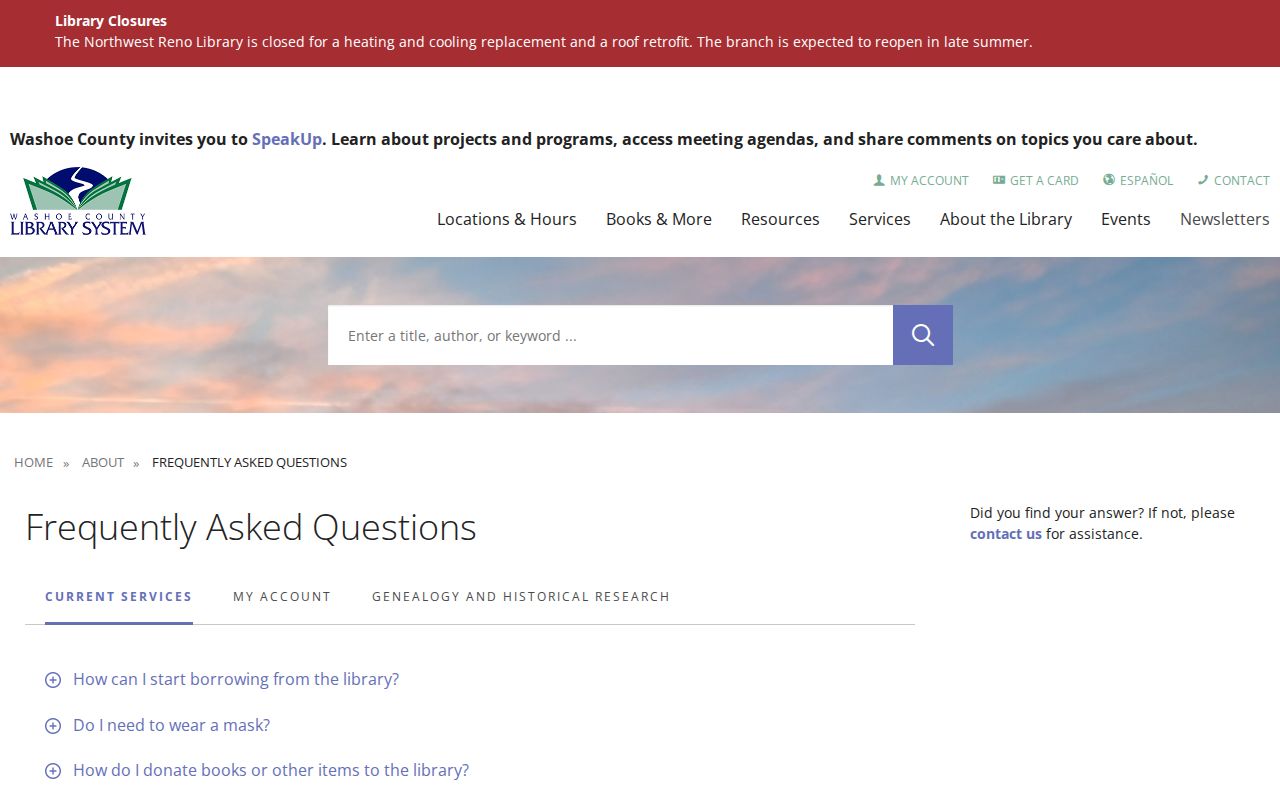
Library assistance can bridge a name-and-address gap, but a directory listing records a point in time rather than a continuous stay at the address.
Sun Valley Directory and Census Pairing
A directory can suggest a person at an address, while a census can record a household on its census date. Neither substitutes for the other. UNR’s City Directories collection includes early Reno, Sparks, and surrounding-area directories beginning in 1900, though the inspected landing page does not post a complete year-by-year inventory or publisher sequence. A modern Sun Valley street may not appear in an early Reno directory even when nearby Reno entries do.
- Record the directory title, publication year, printed name or initials, address, unit, and whether the volume is alphabetical or reverse order.
- Search the nearest publicly released federal census year, through 1950, using the preserved spelling, address clues, relatives, or occupation where visible.
- Compare source dates rather than treating a directory year and census year as the same day. A move, omission, or changed listing policy can explain a difference.
- Check the next available directory volume and the deed dates before inferring a long-term stay, death, or move.
For the historical collections themselves and their access points, the Sun Valley city directory page keeps the focus on the shelf rather than one address trail.
Sun Valley Past-Resident Endpoints
Newspapers, obituaries, cemetery references, and probate can help close or qualify a historical trail, but each supplies different evidence. The Downtown Reno Library’s obituary index covers catalog citations from mid-1962 through September 2007, while full-text Reno Gazette-Journal material is available from 1999 through ProQuest. The library also documents historical microfilm for the Reno Evening Gazette and Nevada State Journal. A citation may identify a date or family connection, not prove residence at a particular address.
A public probate file, when one exists, can be a separate estate clue. Restricted vital certificates, sealed court material, and protected information remain unavailable. Keep names with middle initials, relatives, exact street information, APN, recorded date, and document number instead of merging similar names automatically.
Sun Valley Historical Research Order
Historical access has a practical difference right now. The Nevada Historical Society Research Library is closed for renovation through December 2026, although staff can receive research requests with limited access. Downtown Reno Library and UNR digital or special collections are therefore more practical first stops for an address question, followed by an NHS request for maps, clippings, manuscripts, or county files. NHS has Sanborn insurance maps, but the research did not establish a Sun Valley sheet or year, so verify the map index before naming one.
Washoe Recorder and UNR also have a separate collaboration to scan selected historical record books in high resolution. That is a promising research route, not proof that every older deed book or Sun Valley address is online. A gap in the directory run or map index is itself a result worth recording.
Sun Valley Past-Resident Privacy
A past address record cannot identify everyone who lived there, and a current parcel owner does not prove current occupancy. Protected voter addresses, confidential address-program participants, restricted vital records, sealed court details, and DMV or utility information are outside this address-history path. Nevada’s confidentiality tools can limit information even where an older record remains publicly accessible.
When the evidence conflicts, report it as a conflict. A deed proves a recorded transaction, a directory suggests a listing at a time, and a census describes a household on its enumeration date.